
Ancient Greece Comes Alive for Students with Virtual Reality
Radhika Vaid
Contributing Writer
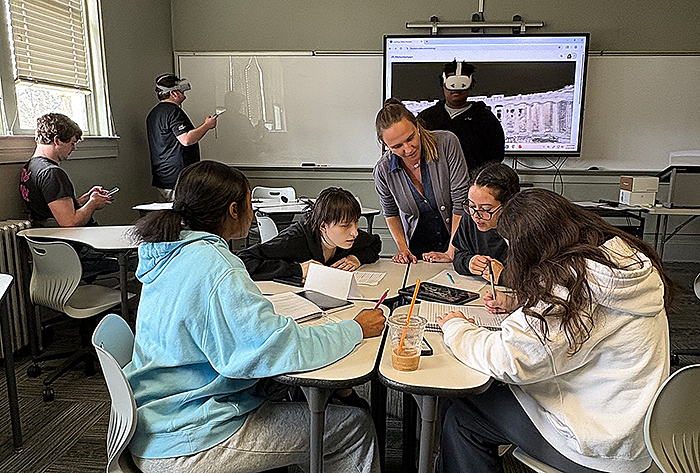
Students in Dr. Melissa Huber L’Heureux’s Ancient Greece history class stepped into the ancient past without ever leaving campus thanks to the technological advancements of virtual reality.
Instead of only reading about the ancient Athenian Acropolis, students explored a virtual reality (VR) reconstruction of the site during class. Using a VR headset, along with a tablet and computer, they took turns navigating the digital landscape and recording their observations for discussion.
“From this experience, students not only gain a better appreciation and understanding of the ancient Athenian Acropolis but also reflect on the strengths and limitations of digital technologies in learning,” Dr. L’Heureux said.
The goal was simple but impactful: to help students better understand what the Acropolis may have looked and felt like in ancient times to better understand ancient Greek life. While few students have the opportunity to travel to Athens, this experience allowed them to virtually “walk” through the space, stand beneath the Parthenon, observe how the buildings were arranged, and consider how people in ancient Athens may have experienced this cultural and religious center.
However, the lesson extended beyond introducing new technology.
“Part of the assignment involved evaluating VR alongside maps, reconstructions, and websites, so students think critically about how different technologies shape our understanding of the past,” Dr. L’Heureux said. “In this use, VR isn’t just a novelty. It’s a tool for helping students connect physical space, cultural meaning, and historical interpretation in a way that traditional materials can’t fully replicate.”
As part of the assignment, students compared the VR experience to traditional resources such as maps, images, and scholarly reconstructions. Through this comparison, they learned that while VR can make history feel immersive and immediate, it is still based on research and interpretation. Digital reconstructions rely on archaeological evidence and informed assumptions, meaning they cannot perfectly recreate the past. By evaluating multiple tools and perspectives, students were reminded that studying history requires both imagination and careful analysis.
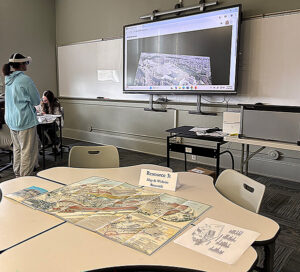
For many students, the experience made a lasting impression. Mia Freymann shared,
“I felt the VR headset made the history feel more real and engaging because it gave us a first-hand experience of what was happening during that time,” student Mia Freymann said.
She added she was impressed by how immersive learning can deepen understanding and make classroom lessons more memorable.
Overall, the VR session blended innovation with thoughtful teaching. Students gained a clearer sense of the scale and significance of the Acropolis while strengthening their ability to question, compare, and interpret historical sources.
“This was a great experience because it felt like I was there and was able to experience the ancient world a little bit more closely,” Freymann said. “Using the technology added a new dimension to history.”